
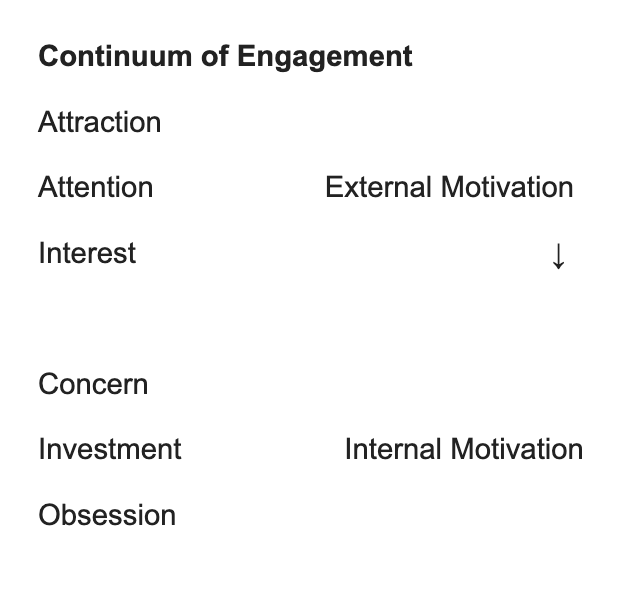
One of the ideas we explored at Spring School was a Continuum of Engagement, originally developed by Dorothy Heathcote as a heuristic device with eight stages to help us think about how learners become increasingly engaged in their learning. The version Tim shared with us reflects and builds on from Heathcote's original work.
The continuum offers a way of thinking about how learners can move from first noticing something to becoming deeply involved in it. The stages aren't a checklist that every child follows in order, but a reminder that deeper engagement takes time to develop.
As Tim guided us through the thinking, and we discussed what it might look like in our own classrooms, I found myself reflecting on how much effort we sometimes put into motivating children from the outside. We plan engaging lessons, search for the perfect hook and try to create enthusiasm, but we can't simply decide what will matter to each child. Perhaps our role is less about manufacturing enthusiasm and more about creating opportunities for children to become interested, building on what matters to them and giving them a reason to become involved.
In Dramatic Inquiry, it can be tempting to put most of our energy into the opening of a story. We introduce a mystery, present an intriguing problem or give the team a commission that captures their imagination. These beginnings matter, but attraction is only the starting point. We also need to think about what will sustain children's interest and give them a reason to keep going.
One part of the continuum that particularly interested me was concern. This isn't simply about worrying; it is the point at which something begins to matter to the learner. The children have a reason to care about what happens and begin to recognise that their own decisions or actions might make a difference.
When planning a Mantle, this asks us to look beyond the initial hook. What might make the team care about the problem? What responsibility could they take on? What new information, decision or consequence might deepen their involvement? We can't guarantee that every child will become invested, but we can plan opportunities that help them move beyond watching the story unfold and become part of the work.
Finding a way in
One of the examples Tim discussed at Spring School has stayed with me because it showed how this can happen in practice.
The group was working within a fairy-tale world, and one child was adamant that there needed to be guns in the story. The idea didn't really fit with the direction the group was taking, and it would have been easy for the facilitator to shut it down and insist that the story continued as planned.
Instead, the facilitator found a way to work with the child's idea, giving him responsibility for collecting the guns and storing them safely in a strong room. Other children then began bringing their own guns to him to be stored.
What interests me about this example isn't really the guns themselves, but the way the facilitator responded. The idea wasn't accepted exactly as it was, nor was it dismissed because it didn't fit the original plan. Instead, it was reshaped into a meaningful responsibility within the story.
The child became someone with an important job to do. Other children had a reason to approach him, and his contribution became part of the group's shared work. An idea that might otherwise have been rejected became a way for that child to participate and connect with others.
The example prompted our group to think about how often children's contributions don't quite fit with what we have planned. Rather than immediately deciding whether an idea is useful, we can pause and consider what might be behind it. What is the child interested in? Is there a way to build on that interest while still maintaining the learning purpose and the needs of the wider group?
Of course, we can't accommodate every idea, and we still need to make decisions about what is appropriate. But this example reminded me that we don't always have to choose between following our plan and responding to a child. Sometimes we can find a way to do both.
Not everyone arrives at the same time
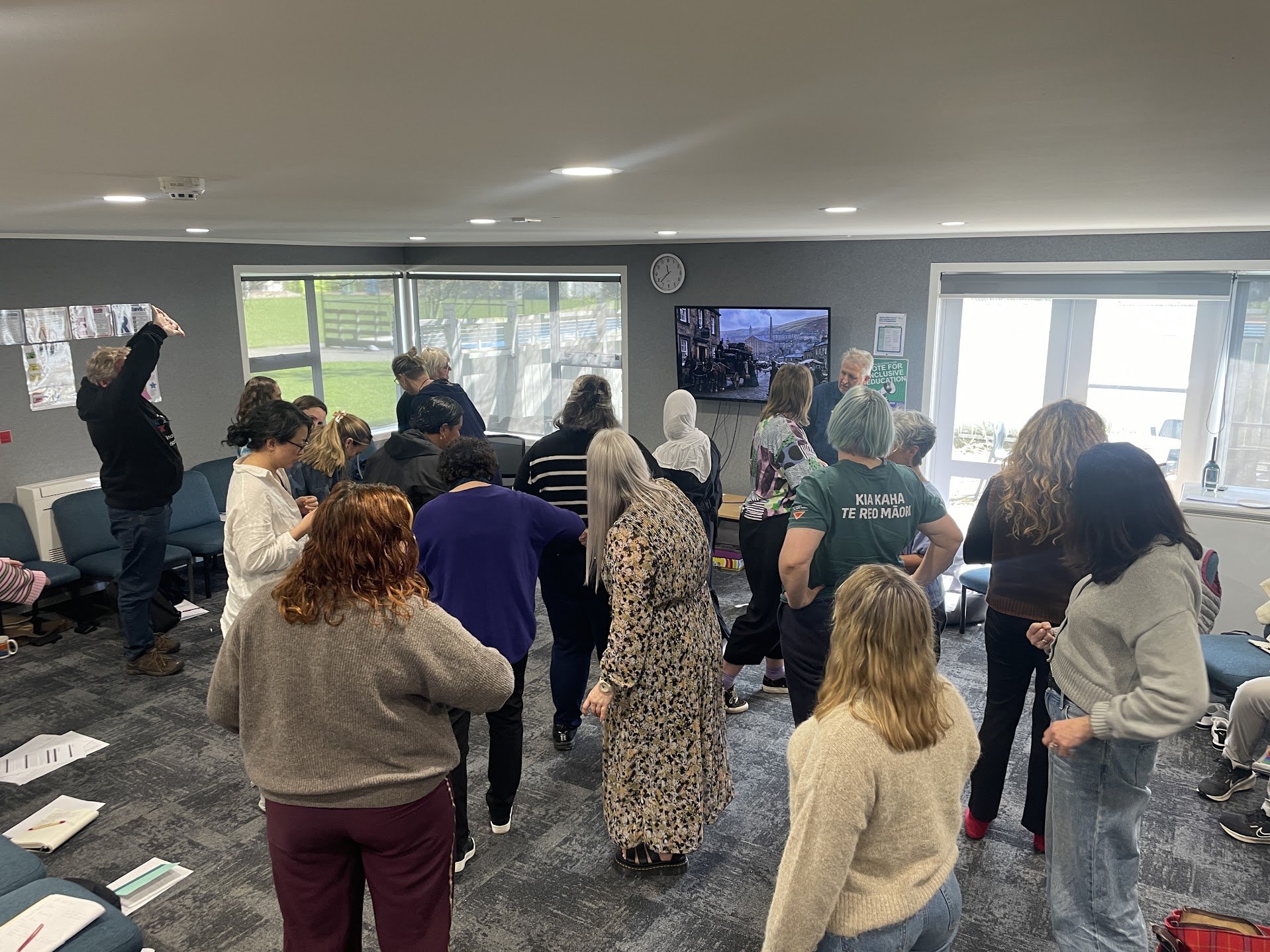
The example also highlights something important about engagement: children don't all find their way into the learning in the same way or at the same time.
Some children are ready to speak, act and make decisions from the beginning. Others might watch quietly, focus on a small detail or take longer to work out where they fit. It can be easy to interpret a lack of visible participation as a lack of interest, but a child might simply need more time or a different opportunity to contribute.
Dramatic Inquiry offers many ways for children to become involved. One might want to take on a role and speak in front of the group, while another might prefer to draw a map, organise equipment, record information or observe before joining in. A child who seems reluctant during one part of the inquiry might become deeply involved when the team needs someone with a particular skill or responsibility.
This asks us to pay attention to what children are actually doing, rather than judging their engagement against our own expectations. We know our classes, their interests and the things that help individual children feel confident. Sometimes we might need to offer a particular responsibility, introduce a resource or give a child more time to make sense of the situation.
We won't always know immediately what will help, but remaining curious gives us more possibilities than deciding too quickly that a child isn't interested.
You can't plan passion, but you can make room for it
The phrase “You can't teach passion, so find it and teach to it” has given me plenty to think about since Spring School.
I don't take this to mean that we abandon our planning or only teach the things children already enjoy. We still have curriculum to teach and knowledge to develop. For me, it is about recognising that children don't all find meaning in the same places, and being prepared to use those differences as opportunities for learning.
The Continuum of Engagement has reminded me to think beyond how I might initially attract children to a story. How might I help their interest develop? What could give them a reason to care? And how might I respond when a child offers an idea that takes us somewhere I hadn't anticipated?
We can't decide exactly when a child will become invested in an inquiry, or what will spark that investment. But we can pay attention, make room for their contributions and create meaningful opportunities for them to become involved.
Sometimes, once children make sense of what is happening and find their place within it, they're off in a direction we could never have planned for ourselves.
