
Spring School Reflection: Repositioning Drama - Not a Subject, but a Pedagogy
One of the ideas that has stayed with me from Spring School came through a conversation about where Dramatic Inquiry actually sits within the curriculum. It was one of those discussions that started with a fairly simple question: if we had to label it as a subject, what would we call it?
Is it Drama? Literacy? Social Sciences? Science? Oral language? The arts? Mathematics?
As Tim guided us through the thinking and we talked it through together, I found myself looking at Dramatic Inquiry slightly differently. Rather than trying to find a particular curriculum box for it, what if we thought about repositioning drama as a pedagogy?
That idea really resonated with me.
One of the strengths of Dramatic Inquiry is that it allows different areas of learning to come together around a shared context, problem, story or commission. Drama can become the way we enter the learning, rather than being the learning itself.
We talked about the way this can change the purpose behind what children are doing. Within a Mantle of the Expert, we might read because our team needs to find something out. We might write because we need to record what we have discovered or communicate something to our client. We might talk because we have a decision to make together. We might draw because we need to explain an idea visually. We might use mathematics because there is a problem our team needs to solve.
The curriculum is still there. We haven't abandoned the learning we need to teach. What changes is the context and the reason for doing it.
This conversation made me think particularly about writing. We often ask children to write for a particular purpose because it is part of our literacy programme, but how often do they actually have a genuine reason for needing that writing?
Within a Dramatic Inquiry, the reason can already exist within the story.
If our team of experts has been asked to investigate dragons, perhaps we need to create a guide about how to spot one. We need to record information so that the rest of our team can use it. We might need to explain how to recognise different types of dragons, where they live and what to do if we encounter one.
Suddenly, writing isn't an activity that has been added to the drama. It has become part of the work of the team.
Another part of our discussions that I found really interesting was Jerome Bruner's three modes of representation: enactive, iconic and symbolic.
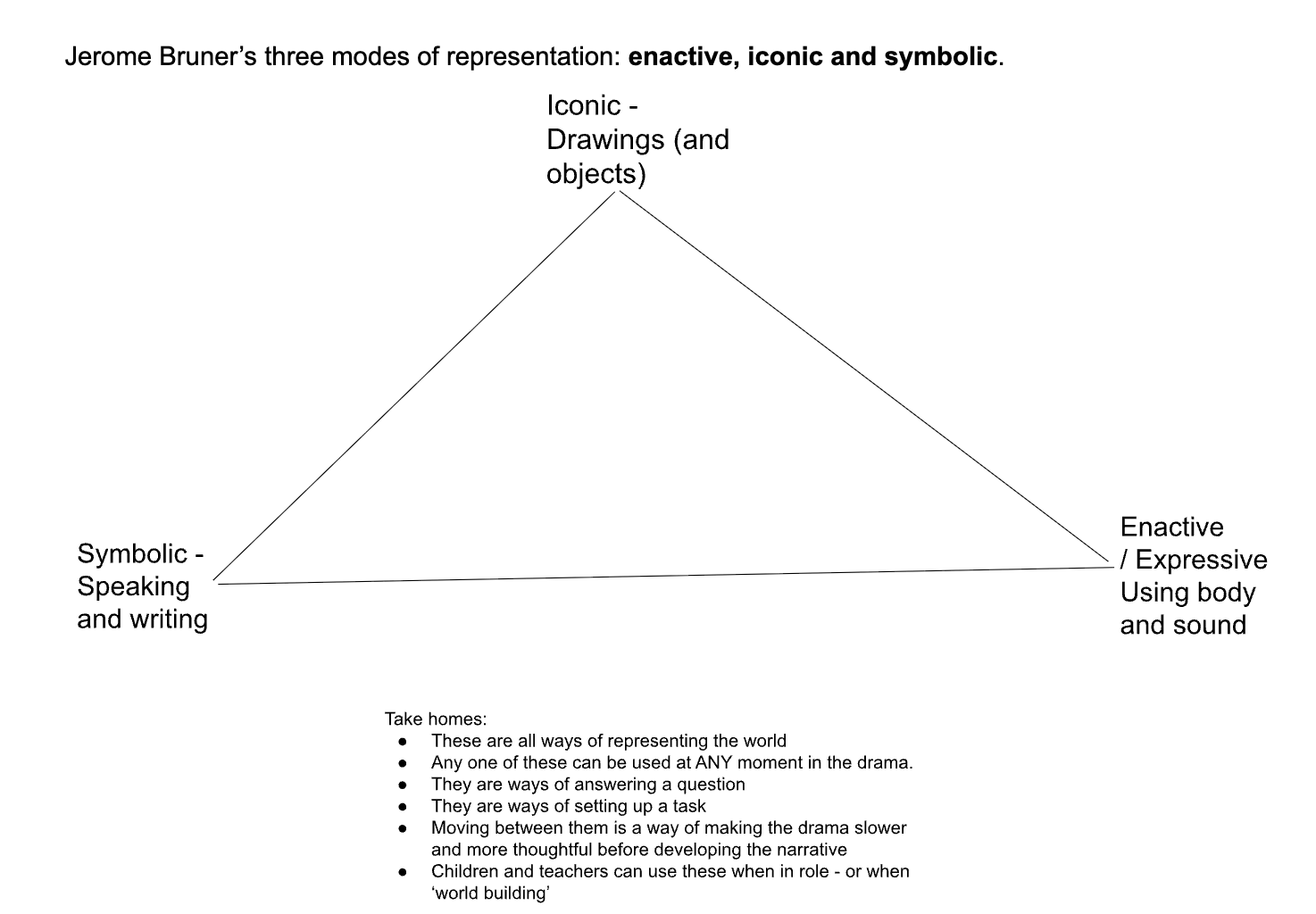
We explored this through the example of becoming a dragon. We could first use our bodies and movement to explore what a dragon might be like. We could then draw the dragon, perhaps creating a diagram of its body or its environment. Finally, we could use spoken and written language to describe, explain and communicate what we had learned.
Talking this through as a group made me think about how often we ask children to move very quickly from an experience into formal reading and writing. There are other ways of thinking and communicating along the way.
A child might experience something physically, talk about it with someone else, draw it, make something, explain it to the group and eventually use more formal language to record their thinking. These aren't necessarily separate activities. They can build on one another.
The conversations around this also brought me back to oral language. When children are working within a shared story world, they have a reason to listen to one another. Someone else's idea might change what the team decides to do. They need to explain their thinking, ask questions, persuade, challenge ideas and sometimes reconsider what they thought they knew.
These are important language skills, but they aren't necessarily being taught in isolation. They are happening because the children need them to participate in the work.
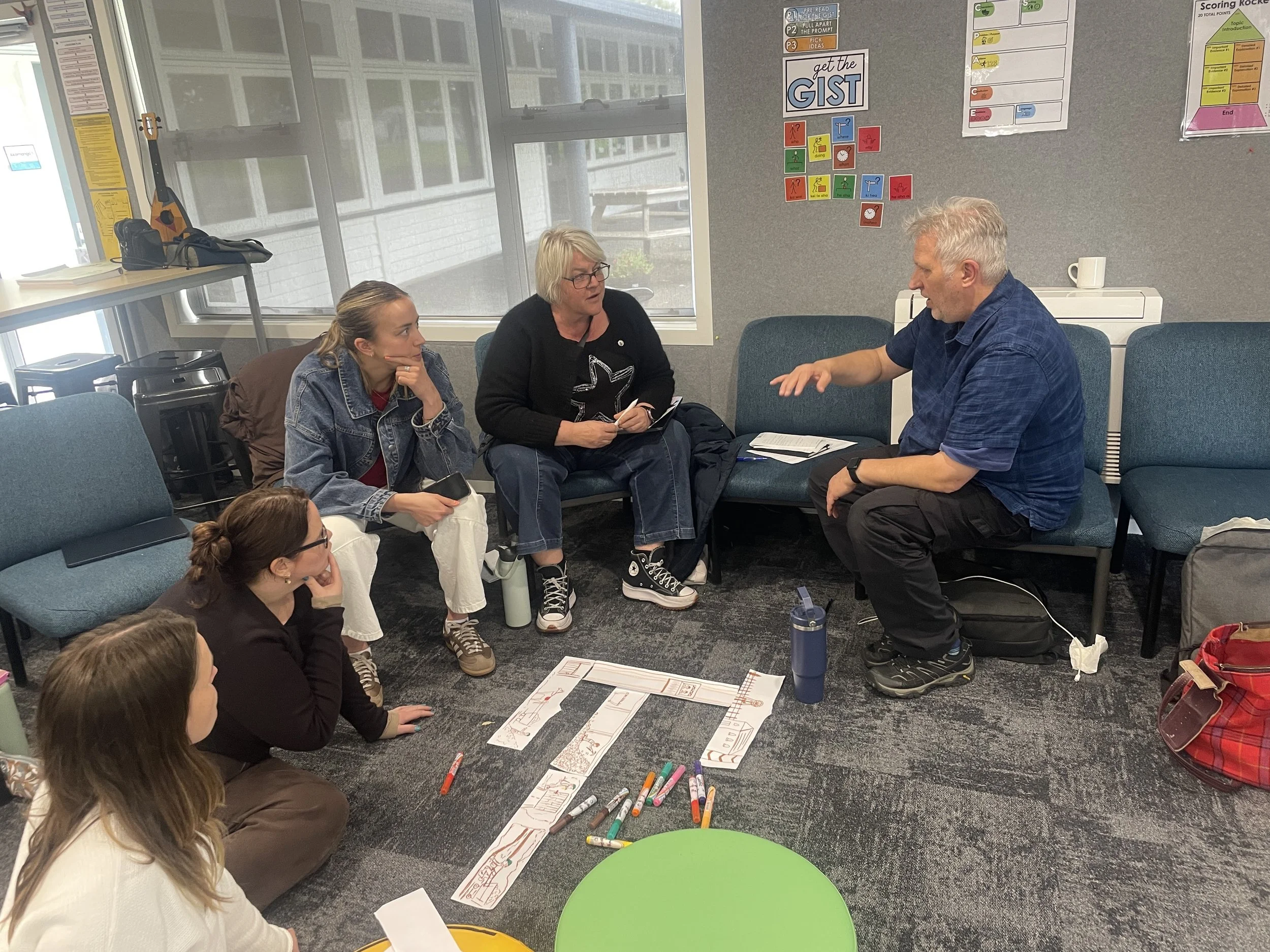
We also talked about the different kinds of texts and representations children create as they work together. An individual child's drawing or piece of writing might begin as their own thinking. When they bring it to the group, it becomes something others can discuss, interpret and build upon. The group conversation adds another layer, and the original idea can develop into something quite different.
I think this is one of the things that makes co-creation so interesting. We can have a framework, a curriculum purpose and a sense of where we might be heading, but we don't necessarily know exactly what the story will become. The children bring their ideas with them.
One phrase from Spring School that has stayed with me was:
“Can you hold on to that? It will be very important. Don't let me forget. We will use that shortly.”
We talked about what it means to hear an unexpected idea from a child and resist the temptation to immediately decide whether it is useful or not. Sometimes we need to hold onto an idea and see where it might take us.
That doesn't mean accepting every idea exactly as it is. We still have a responsibility to shape the learning, maintain the integrity of the story and make decisions about what is appropriate for our particular group of children.
But there is a difference between shutting an idea down and finding a way to work with it.
For me, this is where the idea of co-creation becomes particularly powerful. The children aren't simply completing a sequence of activities that we have already decided upon. They are contributing to something that is being built together, while we as teachers continue to hold the curriculum, the story and the learning purpose.
The more we talked about these ideas at Spring School, the more I began to see why the word pedagogy felt important.
Drama isn't necessarily the thing we are teaching.
It can be the way we create the conditions for children to experience, question, communicate, imagine, problem-solve and make meaning together.
The curriculum areas don't disappear. In fact, they can become more purposeful because the children have a reason to use them.
This has left me thinking about how we plan Dramatic Inquiry. If we start with a curriculum area and then try to find a dramatic activity to attach to it, we might simply be using drama as a strategy.
But what happens if we start with a compelling context, a problem, a commission or a story world and then ask ourselves what learning the children will need in order to do that work well?
That feels like a different starting point.
And I think that is what I took from those conversations at Spring School. Repositioning drama as a pedagogy isn't about finding more time in an already crowded curriculum to “do drama”. It is about considering what might happen if drama became one of the ways through which we approached the curriculum in the first place.
I'm still thinking about what this might look like within the refreshed New Zealand Curriculum and, more importantly, what it might mean for the way I plan and teach.
That is probably the thing I value most about days like Spring School. I don't necessarily come away with all the answers. Sometimes I come away with a different question, or a slightly different way of looking at something I thought I already understood.
This was one of those ideas for me.
