
Too Much to Think About: Helping Children Cross the Blank Page
Imagine a class of six-old children working as a team of Fairy-Tale Problem Solvers.
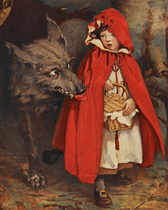
The team helps people facing unusual and difficult situations across the land of Fable. Their previous clients include Jack’s mother, whose son disappeared after a mysterious beanstalk grew in her garden, and the parents of a girl named Rapunzel, who asked for help after their daughter was kidnapped and imprisoned in a high tower.
The team’s latest client is the Queen.
People have been disappearing while travelling through a nearby forest. The Queen has heard troubling stories about a cunning wolf who lives among the trees, tricks travellers and leads them away from the path. She knows that entering the forest will be dangerous, but she wants the team to investigate.
Their commission is to explore the forest, discover where its different paths lead and create a map that travellers can follow. They must also put up signs at important locations and produce a guide explaining how people can stay safe.
The team begins by looking at a partly completed map of the forest, drawn on a large sheet of paper by the teacher. There is a path winding across the map and a hill in the middle. The teacher has also created a list of other things to include: a stream, a wooden bridge, a small thatched cottage and a large old oak tree. The children decide together where to place them and then fill in the rest of the map, using drawings, symbols and short labels to record their ideas.
Once the map is finished, they enact entering the forest and exploring its different routes. Along the way, they stop to examine footprints, broken branches and other evidence of activity. They also encounter various strange and wonderful creatures, including spiders, butterflies and fairies. They even spy a wolf in the distance, apparently sleeping under the old oak tree. They mark these things on their map and decide together which paths are safest, which places to avoid and where to put up signs.
The children create the signs and put them up around the forest. They carry short, clear messages, such as:
Warning! Wolf alert.
Danger! Fallen branch.
Stop! Flooded path.
Working with the teacher, they also create a simple guide containing their most important advice for travellers:
Always tell someone where you are going.
If possible, do not travel alone.
Keep to the path.
Do not talk to the wolf.
Shortly after the guide is finished, a letter arrives at the Problem Solvers’ HQ.
It is from a busy mother whose elderly mother lives in a cottage on the other side of the forest.
Dear Fairy-Tale Problem Solvers,
I hope you can help me.
My elderly mother lives alone in a cottage on the other side of the forest. She is not very well, and I need to send her a basket of food and medicine.
I am unable to make the journey myself, so my daughter has agreed to take it to her. However, I have heard about the people who have gone missing in the forest, and I am worried about letting her travel alone.
I have read the guide you created and wanted to ask if you would meet my daughter at the edge of the forest and help her travel safely to her grandmother’s cottage.
You cannot miss her. She will be carrying a basket and wearing a bright red coat with a hood.
Please take good care of her.
A worried mother
The teacher steps into the story as the little girl, and the children guide her through the forest. She reads the guide as they go and follows its advice: staying on the path, avoiding the wolf and reaching her grandmother’s cottage safely.
Throughout the work, the children write for short, immediate purposes. They label the map, make warning signs and create advice for travellers. Before writing, they have opportunities to draw, talk, explore the forest, meet people and rehearse their ideas through enactment and play.
For an experienced writer, creating a label, warning sign or piece of safety advice may appear straightforward. For a young child, however, even a short piece of writing can involve a wide range of skills and things to remember.
They have to remember what the team has discovered, decide which information is important, choose what warning to give and work out how to express it clearly. At the same time, they have to construct a sentence, choose suitable words, recall spellings, use punctuation and form letters with which they are still unfamiliar.
They are being asked to do all these things at once.
That is a heavy cognitive load.
Making More Space for Thinking
Working memory is limited. It can hold only a small amount of information at any one time, yet writing requires children to manage many things simultaneously. They must decide what they want to say, remember why they are writing, organise their ideas, construct sentences, choose words, spell them, punctuate them and form letters.
For young children, many of these processes are not yet automatic. An experienced writer can spell familiar words or form letters with little conscious effort. A six-year-old may have to devote considerable attention to each one. The more attention these technical demands require, the less capacity remains for thinking about meaning.
The work of the Fairy-Tale Problem Solvers helps by spreading these demands across time and making the children’s thinking visible.
The children do not have to invent the forest, its dangers and the purpose of their writing while also trying to compose sentences. Much of this has already been established through mapping, drawing, discussion and play. The map holds information that the children would otherwise have to remember. The signs and shared guide provide examples of useful language. Enacting the journey allows ideas to be explored and rehearsed before they have to be written down.
These experiences also help the children organise what they know. The map, the sleeping wolf, the missing travellers and the mother’s letter are not isolated pieces of information. They belong to a connected situation that the children understand. When they write Keep to the path or Do not talk to the wolf, they know where the advice came from, who needs it and why it matters.
This reduces unnecessary cognitive load. It does not remove the intellectual challenge or do the work for the children. Instead, it frees more of their limited working memory for the part of the task on which the teacher wants them to concentrate: selecting an idea and communicating it clearly.
That matters for learning because children are more likely to succeed when a task is demanding but manageable. Success allows them to practise making sentences, applying spelling knowledge and using punctuation without becoming overwhelmed by everything else. With repeated practice, some of these processes become more secure and increasingly automatic. They then take up less space in working memory, leaving the child able to manage more complex ideas and make more independent choices.
Although this example involves young children and a fairy-tale context, the same principle can be applied to Dramatic Inquiry with older students. The imagined situation can become more sophisticated, perhaps involving a historical investigation, a scientific emergency or a difficult ethical decision. Students can take on greater responsibility, work with more complex evidence and produce more demanding forms of writing. The context still helps by establishing a clear purpose, audience and body of shared knowledge before they write. It does not reduce the intellectual challenge; it helps students direct more of their attention towards that challenge.
To find out more take a look at our course: Developing Students’ Writing