
Guiding the Way: Reflections from a Mantle Journey – The Sheep Gets Lost
Ehara taku toa i te toa takitahi, engari he toa takitini.
My strength is not that of an individual, but that of the collective.
One week later, I walked through the door for my second day of release in the New Entrant classroom. Almost immediately, children came over asking, "Has Sheepy come to school today?" At that moment, I knew I'd made the right decision to keep the same client throughout the Mantle. The children weren't just interested in the story anymore - they were invested in Sheepy.
Before we officially continued our Mantle after morning tea, I made sure Sheepy was fully involved in our morning literacy and numeracy routines. One unexpected challenge quickly emerged - they all wanted to spend time with him. Without any prompting from me, they had to negotiate whose turn it was, how long each person could have him, and what was fair. Sheepy had quietly become part of our classroom community. Children took turns reading stories to him, teaching him how to count, carrying him around the classroom, and including him in their play.
Before heading outside for morning tea, several children asked if Sheepy could come with them. I told them it was up to Sheepy. After a brief "conversation", Sheepy decided he'd rather stay inside where it was warm and dry. The children happily accepted his decision and headed outside.
When the bell rang, they came racing back into the classroom. Almost instantly someone noticed.
"Sheepy's gone!"
The room buzzed with excitement.
"Maybe he's playing hide and seek!"
Without hesitation, the children launched into a search of the classroom. They looked high and low, inside boxes, under tables and behind furniture. Before long they were organising themselves.
"I've already looked there."
"You search over there."
Slowly, the excitement began turning into genuine concern.
After several minutes, one little boy paused and looked carefully at a piece of paper I'd attached to the whiteboard.
"Mrs Taylor... why is there a picture of Sheepy on the whiteboard? Is it a clue?"
"Maybe it's some evidence," I replied. "Take a closer look."
He carefully removed the paper and, together with another student, turned it over.
"It has writing!"
Within seconds, the note had found its way into my hands, with fifteen eager faces waiting for me to read it aloud. Rather than reading the whole note at once, we stopped after each sentence to think together. Why would Sheepy do that? What do we already know about him?
The children quickly recalled everything we had learned the previous week - he's clumsy, he gets lost and he doesn't know where to go. It struck me just how naturally they were drawing on their prior learning. They weren't simply remembering facts, they were using what they knew about our client to make sense of the problem.
Together, we agreed that before we continued searching, we needed a map of the school. After all, if we didn't know where to look, how could we possibly find Sheepy? We created a bird's eye view map of our school. The children identified familiar landmarks: the bike track around the edge, the astroturf, the field, the playground, the classrooms, the pool and the car park. Once we had finished, we went into the school hall to look at another bird's-eye view map that had been created by some older students a few years ago. It was fascinating to compare our thinking with theirs - what had we remembered? What had we forgotten? What details had someone else considered important?
The children were now desperate to begin the search. Fortunately, Sheepy's note contained more clues. Rather than simply telling us where he was, the note described the journey he had taken through the school. One instruction at a time, we followed his path.
As we walked, we became Sheepy, imagining the same choices he had made and stopping regularly to wonder why he might have gone that way.
One little girl suddenly asked, "But why would Sheepy go outside? He knows he gets lost."
Another quickly replied, "He should have let us take him out at morning tea. Then he would've been safe."
A third quietly added, "I think he missed us and wanted to come and find us."
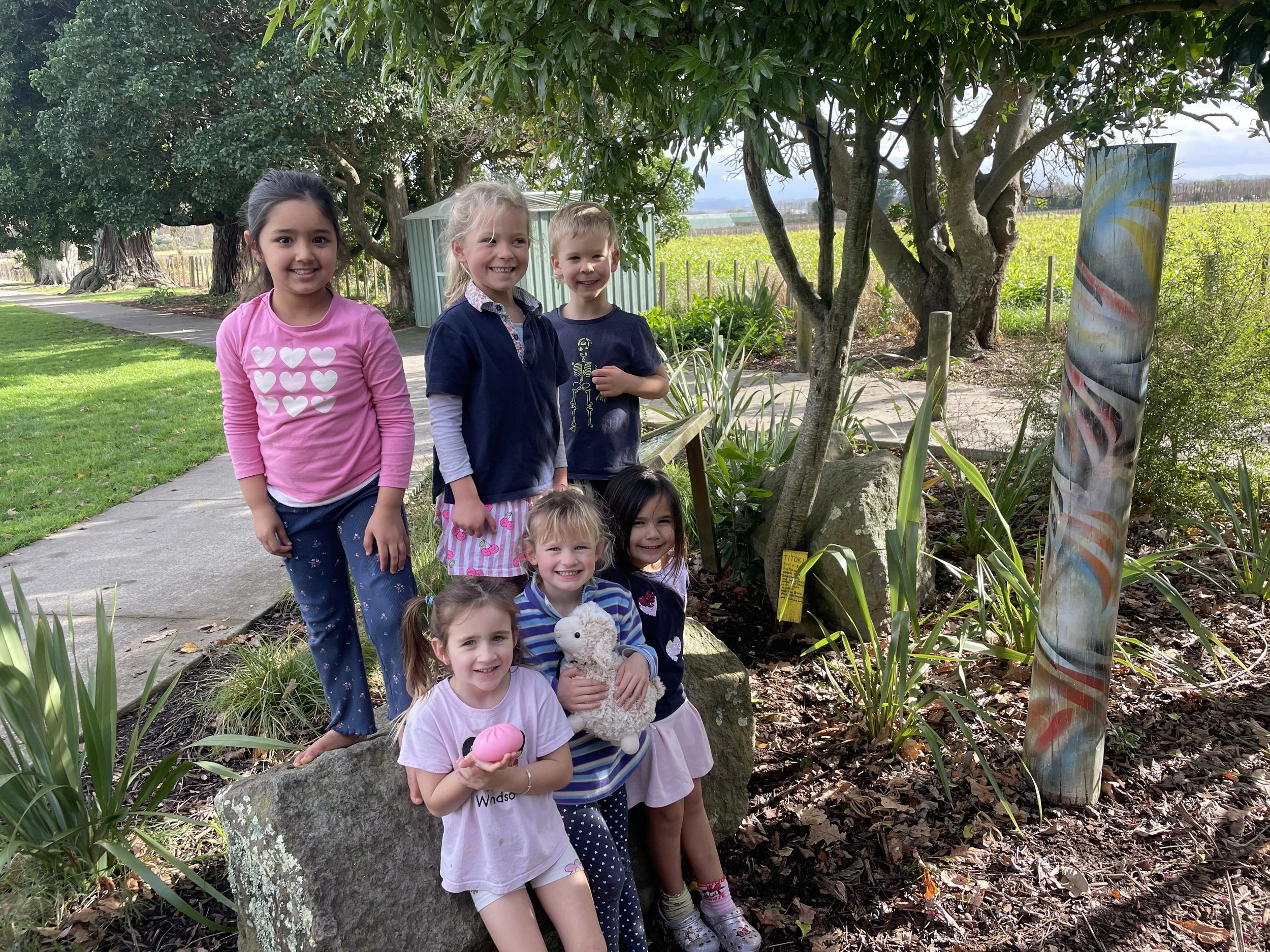
I hadn't anticipated this conversation. The children weren't just following directions anymore, they were empathising with our client. By the time we reached the final clues - "I ran across the field" and "now I'm by a big rock" - the children were calling out to Sheepy as we searched. Then someone spotted him. A small crowd raced through the ngahere to rescue him.
One little boy hugged him tightly before saying, "You're not allowed to go anywhere without us!"
Back in the classroom, we reflected on the adventure. How could we stop ourselves from getting lost? The children quickly returned to the same conclusion they had reached the week before. Maps help us know where we are. Maps help us know where to go.
Using the large map in the hall, we retraced Sheepy's journey before recording it in our books. Some children carefully drew one landmark, while others confidently mapped four or five parts of the journey. The finished pictures all looked different, but each one represented the child's own understanding of the route we had travelled together.
What did I learn?
This lesson reminded me just how powerful continuity can be. Because Sheepy had remained our client, I didn't need to spend time convincing the children to care. They already did. The drama unfolded naturally because they had developed a relationship with him.
What surprised me most, though, was the depth of empathy they showed. They weren't frustrated that Sheepy had wandered off. They wanted to understand why. Once again, I was reminded that the geography wasn't the hook, the relationship was. The map simply became the tool that allowed the children to care for Sheepy and solve a problem together.
As I watched fifteen five-year-olds race through the school calling his name, I couldn't help but smile. The Makaraka Map Makers were well and truly finding their feet.
